Qantas: who ran down the roo?

The following post was originality published in “The Age” on Thursday 14th June 2012
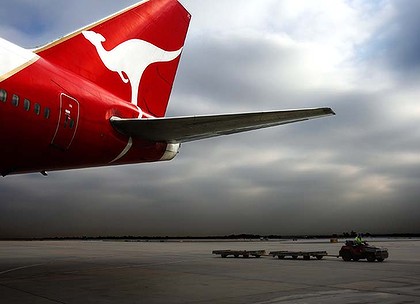
Lost potential … Qantas remains a great international brand, but management has been unable to capitalise on that. Photo: Jessica Shapiro

Before we’re overwhelmed by the drama of Qantas’s potential dismemberment, it’s fair to ask: who ran the roo down and set it up for the chop?

This is where the present and immediately past CEOs will look suitably serious, wearily shake their heads and blame the workforce, other airlines, the weather, the economy, European crises, viruses, the oil price, foreign governments, the Australian government, the alignment of the stars, the flight patterns of penguins – any and everything except themselves and the decisions they’ve made.  And the board of directors standing behind them will nod gravely, pat their appointments on the back and metaphorically say:” Never mind, poor dear, have another million for your troubles.”  Yet the above list of challenges (with the possible exception of the penguins) simply is the business. Managing it profitably and sustainably is the CEO’s very well-paid job. In the case of Alan Joyce’s predecessor, Geoff Dixon, it was his excessively well-paid job.

It’s easy for the CEOs’ apologists to claim that the aviation business itself is insane and loss making, trotting out the usual Warren Buffet story about what should have been done to the Wright brothers. But well-run airlines still make money – including well-run full service “legacy” airlines.  It’s not fair to do a straight comparison of privately-owned Qantas with, say, privately-owned Cathay Pacific – among other things, Qantas has the advantage of a wonderfully profitable domestic franchise that Cathay doesn’t while Cathay has a more flexible and less expensive workforce – but both airlines have had to manage the same big challenges by buying the right sort of aircraft at the right time and flying the routes their customers want with the service their customers demand.  Cathay has managed to do that profitably for its shareholders, while Qantas has just fessed up to losing the thick end of half a billion dollars in one year on its international flights.  That’s quite an achievement, one that isn’t managed overnight. Which is why a broader coronial inquiry is reasonable into who might have killed the international roo before some wide boys might get hold of it, break it up, sell off the bits and flick the remnants.

Talk to some of the old Qantas hands and there’s plenty of blame to go round with Dixon and Joyce being apportioned plenty. They’re not necessarily right, but they make a good case.  Those who know much more about aviation than I do claim Qantas made mistakes in building up a hodgepodge fleet of different aircraft types with attendant higher servicing and parts costs. Blame the Dixon era.  Now Qantas is stuck with an aging fleet that is fuel expensive and is deferring the 380s it needs to be competitive while giving its first 787 to Jetstar. Blame Joyce.

A recent Financial Times story introduced me to the delightful chess term “zugzwang” – being in the position of having to make a move but when any move will put the player in a worse position. It might appear that Joyce is in Zugzwang Central.   To have a viable international full-service offering, Qantas needs new, more fuel-efficient aircraft and to fly the routes people want. The recent Qantas history has been one of surrendering routes one after the other and it is continuing to do so. On its current trajectory, Qantas’ international network will consist of New Zealand – or less.  But buying new planes costs money and would eat into the cash Joyce seems to be hoarding for his Jetstar ambitions – or for making the company an attractive target for carve up. And making routes work requires marketing and service levels that win customers, plus local knowledge. It’s expensive and if you don’t do it really well, you can lose even more money and cop a golden parachute.

One of the complaints about the James Strong/Geoff Dixon period was that the top levels of management were filled with executives without international experience, people who had no idea of how to turn an aircraft around as efficiently as possible in a foreign port and with little understanding of or feel for foreign markets. It was a takeover of international Qantas by domestic TAA (Trans Australia Airlines).  That could be the bleating of embittered former staff, but you can hear those stories from people who remain gainfully employed and respected in international aviation.  Qantas remains a great international brand – cue Dustin Hoffman’s Rainman – but management has been unable to capitalise on that, as demonstrated by the massive loss and shrinking network.

Then there’s the problem of Qantas’ industrial relations. Parts of its workforce are very expensive indeed on any international comparison, most obviously the cost of its CEOs and its baggage handlers. Both are paid much more than those at the competition. Baggage handling is a semi-skilled occupation but Qantas bag tossers are paid considerably more than the average wage. They can earn more than teachers and nurses.  You can blame a strong union for that – or Qantas management for not doing what the job title implies: managing. As for the obscene level reached by Geoff Dixon’s pay packet – a multiple of his airline peers’ salaries – that’s all the board’s own work.  For the baggage handling costs, the option exists for outsourcing that part of the operation. If the workforce won’t come with airline on the competitive journey, it needs to be changed.  There’s a danger that the separation of Qantas international and the announcement of that big loss is desired to frighten the workforce into greater flexibility but has managed to make the company a target instead. The adversarial model employed these many years – shades of old school IR – demonstrably hasn’t worked. Maybe because it hasn’t been adversarial enough, maybe because the workforce just doesn’t believe the CEO. In either case, the CEO has to take responsibility.

And talking of suspicion, the one that Qantas has been subsidising the success of Jetstar’s growth is widely spread among the Roo’s workforce. That an aircraft that Qantas needs – the 787 – is going to the low cost carrier rankles with those who still think the Qantas brand is worth something. Inheriting a world-class business and overseeing its creeping demise is nothing to be proud of. Cannibalising part of the old Qantas business with a low cost alternative was necessary, but pushing that cannibalisation to the point of exterminating the parent becomes dangerous.

As the sharks circle, threatening to slice and dice for a quick profit and run, the board should have plenty to ponder deeply.

Michael Pascoe is a BusinessDay contributing editor.

http://www.theage.com.au/business/qantas-who-ran-down-the-roo-20120614-20bvt.html
In war,the first casualty is the truth….

Conservative commentators on the Qantas grounding are playing loose with the truth.

In grounding the entire domestic and international Qantas fleet last month, the firm’s chief executive, Alan Joyce, claimed the action was the only way to stop the unions’ industrial campaign. The implication was that grounding the planes was the only way to have Fair Work Australia (FWA) intervene and order a stop to all industrial action.

In the weeks since, a number of anti-union ”cold war” industrial relations warriors, including Peter Reith, Chris Corrigan, economist Judith Sloan and coalition politicians, have thrown themselves into the debate, questioning the efficacy of the Labor government’s Fair Work Act. The common theme is that the grounding of the Qantas fleet demonstrated the weakness of the act, because the company had no other way to get FWA to order a cessation of all industrial action other than by grounding its entire fleet. This is patently untrue.

To understand the massive hoax being played on the Australian community by both Qantas management and numerous conservative commentators, it is necessary to distinguish between Joyce’s notice of an intention to lock out his employees from 8pm on Monday, October 31, and his grounding of the entire Qantas fleet two days before that date. Of these two steps, only the first was ”protected” industrial action. There was no need for the grounding of the Qantas fleet to have FWA order a stop to all industrial action. Simply announcing in advance that a lockout was to occur would have been sufficient to invite FWA to issue orders stopping all industrial action.

Under section 424(1) of the Fair Work Act, “FWA must make an order suspending or terminating protected industrial action that . . . is threatened, impending or probable” where it is likely ”to cause significant damage to the Australian economy or an important part of it”. In other words, the industrial action did not need to occur, but rather it only had to be “threatened, impending or probable”.

Let’s be clear here. Qantas only had to announce its intention to initiate a planned lockout of its employees to invite FWA to suspend or terminate all industrial action. Once convinced of the impending damage to the economy, FWA had no discretion under the act other than to suspend or terminate protected industrial action. So the claim that Qantas had no option but to lock out its employees in order to get all industrial action stopped is nonsense. But there is more subterfuge by Qantas management here.

Having announced on Saturday afternoon that a lockout was to be enforced as of Monday at 8pm, why did Qantas ground its entire fleet on the Saturday, before FWA could possibly hold a hearing and stop all industrial action? Why indeed?

The explanation offered by Joyce was that ”individual reactions to this lockout decision may be unpredictable . . . for this reason, as a precautionary measure, we have decided to ground the Qantas international and domestic fleet immediately”. Qantas grounded its fleet because it apparently had no faith in the professionalism of its own pilots and ground staff.

If Qantas management genuinely thought that the worry, stress and distractions to their pilots caused by the impending lockout could jeopardise passenger safety, then presumably management’s current plans for outsourcing and staff cuts would equally pose a safety risk.

Following the logic of Qantas’ ”risk assessment”, it should ground all its flights until the company’s planned restructuring is fully completed.

In the hearing before FWA, there was no indication from members of the full bench that they agreed with Joyce’s odd rationale. In any case, FWA was concerned with preventing the airline’s planned lockout of its staff. Ultimately, the Fair Work Act worked smoothly, with FWA holding a full bench hearing and then ordering a stop to Qantas’ planned lockout. In the end, there was no lockout and not a single worker lost a day’s pay.

So, what does this episode tell us about Qantas and the current state of industrial relations in Australia? It exposes a senior management team willing to trash its own company’s brand, cause irreparable harm to the Australian economy as well as inconvenience its customers for stated reasons that defy logic.

It is worth noting that FWA found that the unions’ industrial campaign had not caused significant economic harm, as Qantas pilots had not taken any strike action, instead restricting their campaign to making in-flight announcements airing their grievances to passengers. The only factor causing significant economic damage was management’s grounding of the fleet.

There was nothing about the events of that weekend that call into question the efficacy of the Fair Work Act. Ultimately, the government intervened when it received notification of the Qantas decision and a full-bench hearing of FWA took place, leading to the termination of all industrial action, well in advance of the planned commencement of the lockout. By any measure, the Fair Work Act came out smelling of roses. Qantas, on the other hand, has a rather different odour about it.

Bruce Hearn Mackinnon is a senior lecturer in human resource management at Deakin University.

This was originally posted by The Age at the following URL  http://www.theage.com.au/opinion/politics/facts-fly-under-the-radar-20111116-1nj57.html#ixzz1dvfff3nt

Qantanomics, the Airline that stopped a nation.

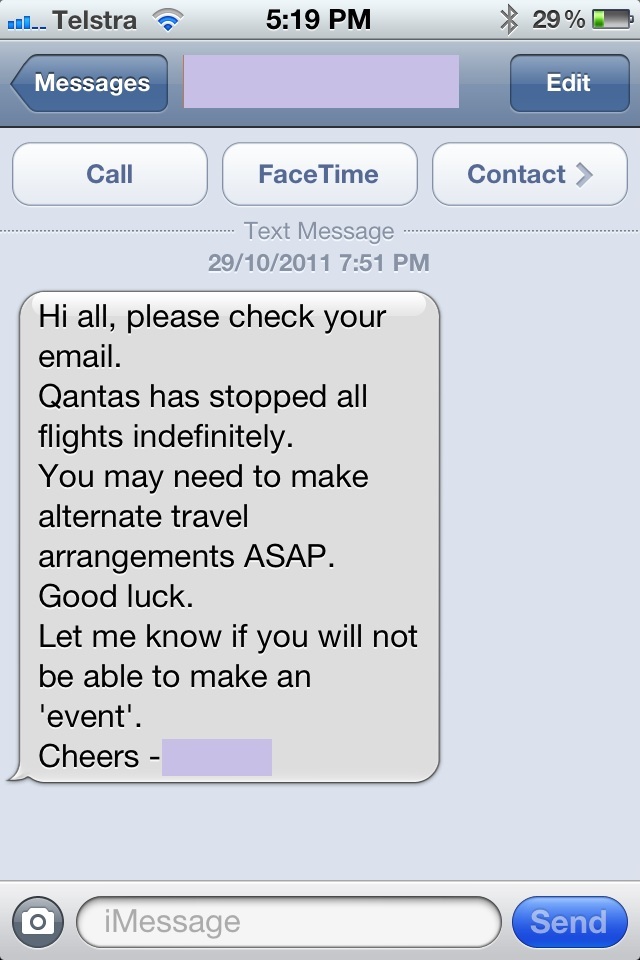
What a week in the Australian Airline Industry. On Saturday 29th October, I got a text message from my National Project Manager.

I smell trouble…

Qantas has shut down the Australian Air Travel Market, 68000 people affected, no stranded and the message from my political masters is “Good Luck”. They have other staff to worry about. It was the people who were sitting on aircraft and asked to disembark before taking off and the passengers who were in mid flight and turfed into Hotels in Singapore and Hong Kong who I felt for. In the latter, some were asked to share with fellow passengers.

But this was the intro to another battle, the industrial relations at the heart of the matter. The unions involved had promised 12 months of rolling stoppages in the ilk of “death by a thousand cuts” and this was something that the “Spirit of Australia” and the Irish CEO was not going to stand for, understandably. I could not help but think it was timed around the Melbourne Cup because it would effect less domestic business travelers and the “race that stops a nation” is sponsored by a competitor.

I noticed that the Airline Pilot’s union is back in the Federal Court trying to extract an exemption to wear the red ties (their a militant bunch) or something to that effect.  Alan, if a group of professionals want to protest by wearing red ties and you see this as the threat to your business model, I suggest you drink less coffee in the mornings!

What a storm in a tea cup – well I was not affected!  By Tuesday all was back to normal and the million hours of coverage was, well History.  We are flying again but for how much longer is anyone’s guess.  What I found all very oddwas the 250 odd people affected by the A380 landing in Dubai due to an engine problem.  This was a few days  after Qantas was up and flying again.  I thought they had thousands of stranded customers but two after normal resumption of service, a air frame that carries 450 people only had 258 passengers.  With a 55% loading, remind me again exactly how many people were stranded but the shutdown?

Qantas Club belly

A few weeks ago I mentioned that the Qantas Club Lounge is Canberra was akin to a tip.  I had not been back in since then and but today, wow, what a transformation.  It is so clean, you can eat from the floor. No dirty coffee machines, mountains of dirty plates and a general trashiness that is was.  But all this cleanliness has come at a price. I stood at the bar for 5 minuets waiting for a drink.  The manager walked past and asked if I wanted anything.  I had to refrain in my comments!  She obviously has a new directive: clean, clean, clean and do not worry about the service.  Ah well, maybe next week will make for a better balance!