Qantas: who ran down the roo?

The following post was originality published in “The Age” on Thursday 14th June 2012
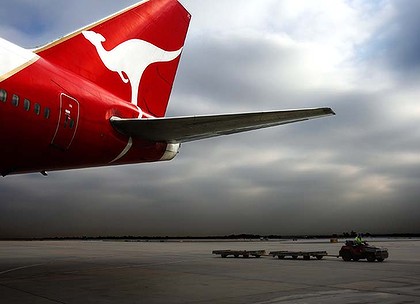
Lost potential … Qantas remains a great international brand, but management has been unable to capitalise on that. Photo: Jessica Shapiro

Before we’re overwhelmed by the drama of Qantas’s potential dismemberment, it’s fair to ask: who ran the roo down and set it up for the chop?

This is where the present and immediately past CEOs will look suitably serious, wearily shake their heads and blame the workforce, other airlines, the weather, the economy, European crises, viruses, the oil price, foreign governments, the Australian government, the alignment of the stars, the flight patterns of penguins – any and everything except themselves and the decisions they’ve made.  And the board of directors standing behind them will nod gravely, pat their appointments on the back and metaphorically say:” Never mind, poor dear, have another million for your troubles.”  Yet the above list of challenges (with the possible exception of the penguins) simply is the business. Managing it profitably and sustainably is the CEO’s very well-paid job. In the case of Alan Joyce’s predecessor, Geoff Dixon, it was his excessively well-paid job.

It’s easy for the CEOs’ apologists to claim that the aviation business itself is insane and loss making, trotting out the usual Warren Buffet story about what should have been done to the Wright brothers. But well-run airlines still make money – including well-run full service “legacy” airlines.  It’s not fair to do a straight comparison of privately-owned Qantas with, say, privately-owned Cathay Pacific – among other things, Qantas has the advantage of a wonderfully profitable domestic franchise that Cathay doesn’t while Cathay has a more flexible and less expensive workforce – but both airlines have had to manage the same big challenges by buying the right sort of aircraft at the right time and flying the routes their customers want with the service their customers demand.  Cathay has managed to do that profitably for its shareholders, while Qantas has just fessed up to losing the thick end of half a billion dollars in one year on its international flights.  That’s quite an achievement, one that isn’t managed overnight. Which is why a broader coronial inquiry is reasonable into who might have killed the international roo before some wide boys might get hold of it, break it up, sell off the bits and flick the remnants.

Talk to some of the old Qantas hands and there’s plenty of blame to go round with Dixon and Joyce being apportioned plenty. They’re not necessarily right, but they make a good case.  Those who know much more about aviation than I do claim Qantas made mistakes in building up a hodgepodge fleet of different aircraft types with attendant higher servicing and parts costs. Blame the Dixon era.  Now Qantas is stuck with an aging fleet that is fuel expensive and is deferring the 380s it needs to be competitive while giving its first 787 to Jetstar. Blame Joyce.

A recent Financial Times story introduced me to the delightful chess term “zugzwang” – being in the position of having to make a move but when any move will put the player in a worse position. It might appear that Joyce is in Zugzwang Central.   To have a viable international full-service offering, Qantas needs new, more fuel-efficient aircraft and to fly the routes people want. The recent Qantas history has been one of surrendering routes one after the other and it is continuing to do so. On its current trajectory, Qantas’ international network will consist of New Zealand – or less.  But buying new planes costs money and would eat into the cash Joyce seems to be hoarding for his Jetstar ambitions – or for making the company an attractive target for carve up. And making routes work requires marketing and service levels that win customers, plus local knowledge. It’s expensive and if you don’t do it really well, you can lose even more money and cop a golden parachute.

One of the complaints about the James Strong/Geoff Dixon period was that the top levels of management were filled with executives without international experience, people who had no idea of how to turn an aircraft around as efficiently as possible in a foreign port and with little understanding of or feel for foreign markets. It was a takeover of international Qantas by domestic TAA (Trans Australia Airlines).  That could be the bleating of embittered former staff, but you can hear those stories from people who remain gainfully employed and respected in international aviation.  Qantas remains a great international brand – cue Dustin Hoffman’s Rainman – but management has been unable to capitalise on that, as demonstrated by the massive loss and shrinking network.

Then there’s the problem of Qantas’ industrial relations. Parts of its workforce are very expensive indeed on any international comparison, most obviously the cost of its CEOs and its baggage handlers. Both are paid much more than those at the competition. Baggage handling is a semi-skilled occupation but Qantas bag tossers are paid considerably more than the average wage. They can earn more than teachers and nurses.  You can blame a strong union for that – or Qantas management for not doing what the job title implies: managing. As for the obscene level reached by Geoff Dixon’s pay packet – a multiple of his airline peers’ salaries – that’s all the board’s own work.  For the baggage handling costs, the option exists for outsourcing that part of the operation. If the workforce won’t come with airline on the competitive journey, it needs to be changed.  There’s a danger that the separation of Qantas international and the announcement of that big loss is desired to frighten the workforce into greater flexibility but has managed to make the company a target instead. The adversarial model employed these many years – shades of old school IR – demonstrably hasn’t worked. Maybe because it hasn’t been adversarial enough, maybe because the workforce just doesn’t believe the CEO. In either case, the CEO has to take responsibility.

And talking of suspicion, the one that Qantas has been subsidising the success of Jetstar’s growth is widely spread among the Roo’s workforce. That an aircraft that Qantas needs – the 787 – is going to the low cost carrier rankles with those who still think the Qantas brand is worth something. Inheriting a world-class business and overseeing its creeping demise is nothing to be proud of. Cannibalising part of the old Qantas business with a low cost alternative was necessary, but pushing that cannibalisation to the point of exterminating the parent becomes dangerous.

As the sharks circle, threatening to slice and dice for a quick profit and run, the board should have plenty to ponder deeply.

Michael Pascoe is a BusinessDay contributing editor.

http://www.theage.com.au/business/qantas-who-ran-down-the-roo-20120614-20bvt.html
The @QantasAirways mob are usually an astute bunch but this #frequentflyer deal ….

I was having a look at the Frequent Flyer Reward flights and found what can only be a stuff up on behalf of Qantas.

The people who run Qantas despite what I may have to say about them are a very astute group of people.  You may not always agree with them but the airline, despite my ramblings, is a slick operation.  The international side needs some finessing but by and large, they get by.

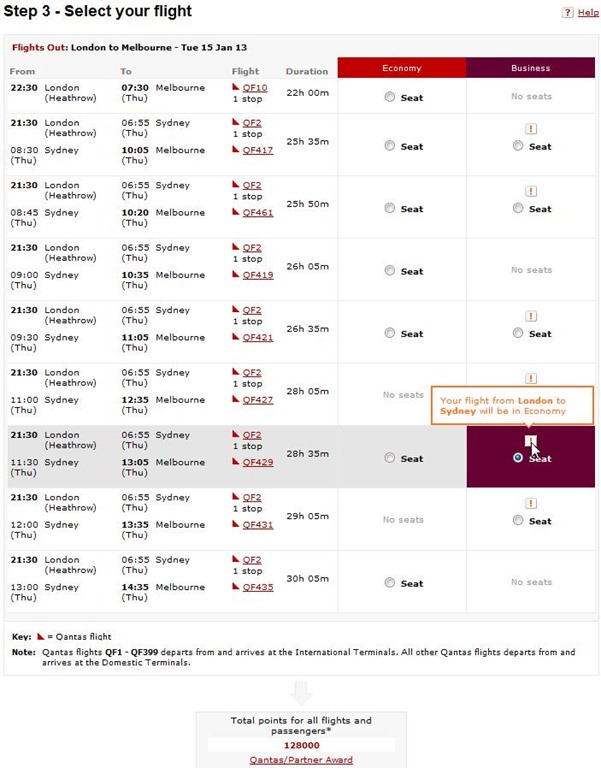
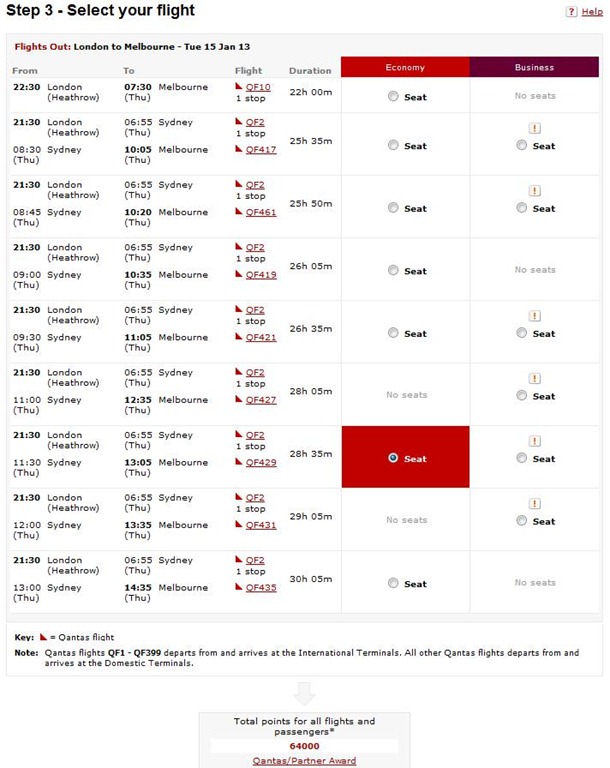
Back to the Frequent Flyer redemption search.  I was able to select a flight from London (LHR) on QF2 to Sydney and then domestic through to Melbourne.  If I book the Economy option all the way, the cost is 64,000 points and about half the cash fare again in tax’s and surcharges.  I works out to be a 66% discount with no status credits or ff points.

ScreenShotM167

This is where the problem is!  If you book the Business Redemption flight, you are charged 128,000 points but and this is a monster BUT, the leg from London to Sydney on QF2 is in Economy.  Hold the phone.  For an hour and a half in a 767 that is most likely older than your Great Grand Mother you get to pay an additional 64,000 points for 1/25th in domestic business and a glass of OJ before you take off in Sydney.  Just to put your mind at reat that this is no joke, the same let from Sydney to Melbourne on QF429 in Business is 16,000 points.  By splitting up the return leg, you can save your self 48,000 points.  They think we are fools!

ScreenShotM166

As I said earlier, they are a smart mob at Qantas but some one has been out for a very long lunch and probably should not have come back to the office that afternoon!  Maybe this was Sid’s parting gesture!

Did I hear you say….

I will be the first to admit that I have been very tardy in the past month delivering my weekly repertoire on my time in spend in the tail of the national emblem.  And it has been an exciting time for Qantas.

Out with the old, in with the new.

The redQ experiment is over.  By all accounts it was an ill-conceived and poorly executed plan and would appear to be a more smoke and mirrors exercise.  Scare the shit out of the unions by threatening to move 10% of the business offshore.  After Alan’s mouth had stopped moving and the reality of what he had said was starting to sink in it must have dawned on him that he was going to try and copy the Singapore/Arab model and hope the competition said, no problems.  That was never going to work, so plan B.  Lets talk to China.  We have the safety record and they have the population record – now there is a good model.  Time will tell if this is a good idea or more the 1 + 1 = 3 variety of Qantas planning.

Stuck in traffic?

Tuesday morning, all neatly tucked up in seats, eyes forward. feet flat on the floor waiting for the calisthenics display from the cabin crew.  The door had been closed and the cabin was being pressurised, or what ever they do to make the trip more “comfortable”.  Announcement from the captain, who I might add was female and made for a pleasant surprise (think multi tasking, more women pilots please!).  We are a little behind on the pre-flight paper work as we, the flight crew, were stuck in traffic on the way to the airport.  Qantas have a dim view of late arrivals and over at Jetstar, that’s akin burning cash.  But if you are at the controls, take you time!  It reminds me of George Orwell’s Animal Farm after the pigs had taken over.  One rule for us and one rule for them!

I like my food to move.

Picture this, crammed in the back of an A380, complementary bar snacks at the end of the cabin (that is qantanomics for less staff) and in your snack bag you find movement.  Now this is not the movement that the Banjo Patterson poem was talking about “There was movement at the station, for the word had passed around”.  In the sealed fruit and nut bag was something alive that was not meant to be there.  The press had a field day, the offended customer ,Victoria Cleven was offered a cash payment and the poor bastards in the bag were most likely incinerated by AQIS.  Had the customer been in the pointy end or the top deck of the plane, she would have been offered more “hush money” but by the same token, the stewards (no self service there) may have noticed the offending bug.

Movements in the shadows.

My mate Sid Gokani (figuratively speaking) at Qantas has had a brilliant idea.  Those kids at Virgin Australia are making in roads and causing Alan and Sid a bit of bother under the collar, so Sid is offering double status credits to selected frequent flyer members for all flights booked and flown In April to June.  Status credits are those pesky points that you earn from flying and show the airline how important you are, as opposed to frequent flyer points that you get for not flying like school fees and petrol.  This is great.  Now everyone will be gold or platinum, so much for be exclusive.  Something tells me the shadows from Virgins Brisbane bunker are making the kids in the Mascot Bunker worried.  It is a little like reading a v Spy v Spy comic.

Jetstar, say no more…

I ran a survey in the office during the week.  I rounded up the 15 consultants that I work with and who all travel, like I do, to get to work each week. As a background, they come from everywhere, Perth, Townsville, Brisbane, Hobart, Melbourne, Sydney and Adelaide.  The general consensus is “do not fly Jetstar”.  I could not find anyone who had a good word to say about it.  Interestingly, Jetstar do not fly from Canberra, you can only get Qantas or Virgin flights and Virgins schedule is not as complete as Qantas so Canberra really is a one horse town.

Did you want leg room with that seat?

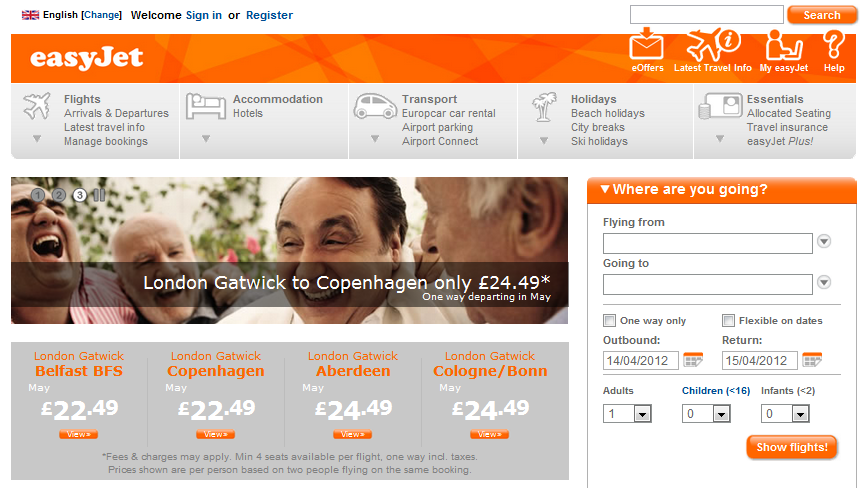
The Friday flight is a little like ground hog day. I see the same faces each week in the same way you see the same people on the train to work or in the coffee shop.  Canberra flights are no different.  Every now and again Qantas change the plane, so instead of a 734 we get a 738.  For those not in the know, 734 is a 737-400 and 738 is a 737-800, ah jargon!  I could not help but notice that it was ever so tight in the 738.  The new 737’s have more seats and less room – hang on that is what operators like Ryan Air and Easy Jet do, except and this is a big except.  You can fly from the Uk to Denmark for £24.49.  Even if they add 300% in tax, it would still be worth it!  But Alas, Qantas is not easy Jet yet and they certainly charge more than £24.49.

image

Please switch off your mobile phone.

The guy sitting behind me and the hostess had what could only be described as avibrant discussion about his iPhone when coming into land today. The hostess pointed out that it was a CASA requirement to turn off all electrical equipment and that by putting the phone in flight mode this was not sufficient.  The passenger pointed out that most of the passengers on the plane probability still had phones and the like turned on.  The hostess was not having any of this and proceeded the give the passenger direction on powering down the phone.  Good one Qantas, yet anther happy customer but there is a salient point in this.  If the phone, in flight mode is so dangerous, why allow them at all.  From where I am sitting I can see the ground.  When flying at night or above cloud where you can get visual references from the ground, if a passengers phone sent the the auto pilot on another course, on one would be the wiser.  I actually think it is more to do with exit speed in an emergency.  If a place crashes when landing survival rate 50/50 at very best, at 11 kms up, survival rate 0.  It is not the mobile phone per-say but how fast you can run with the thing plastered to your ear, so unless you are Jack Bauer or James Bond, turn the phone off, or at least hide it from the fun police.

Happy running and in the immortal words of Donkey from Shrek, “stay away from the light” or the Qantas hostess, follow the arrows away from the plane!

Qantas, private equity? chaos? QRed just went nowhere!

The upheaval in global aviation left Qantas boss Alan Joyce with little choice but to propose a subsidiary Asian carrier, which infuriated the unions. Now the upheaval in global markets, courtesy of Europe’s problems, has reportedly forced him to abandon those plans in favour of an alliance with Malaysia Airlines. And all the while those private equity rumours just won’t go away, such is the state of things at Qantas these days – chaotic.

The European debt crisis looks to have scuttled the controversial plans of Qantas Airways boss Alan Joyce for a separate Asian-based carrier, but it can’t squash rumours of a private equity tilt at the flying kangaroo. According to the Australian Financial Review, the turmoil in Europe has spooked Qantas management and they’re preparing to dump a planned multi-million dollar investment in a subsidiary Asian airline in favour of a less risky alliance with Malaysia Airlines. While unions might claim this as a victory, the paper says Qantas is firm in its stance on the job security claims of the unions.

The news comes after speculation re-emerged over the weekend of a private equity bidder for Qantas . According to The Weekend Australian, former Qantas boss Geoff Dixon and John Singleton considered taking a strategic stake in Qantas three months ago, but were turned off by a darkening outlook for equity markets. The theory is that someone with greater capital firepower might still be hanging around. The indicative $700 million bid by Private Equity Partners for Spotless Group has fuelled rumours of increased private equity activity in the Australian market, despite the obvious turmoil in Europe, and much of it has centred on Qantas . While Dixon wasn’t ready to ride the current market waves with his own money – the paper says investment banker Mark Carnegie, Singleton and Dixon are set to launch a $200 million pub fund instead, which could list on the ASX – in Qantas he said it would not be surprising if other players were taking a look at his former employer.

via BREAKFAST DEALS: Qantas chaos | Alexander Liddington-Cox | Wheels and Deals | Business Spectator.