Back to Basics

I started this blog as a homage to the in-flight service from Qantas on my weekly flight from Canberra back home to Melbourne. The genesis was a email that I sent to friends lamenting the service v price ratio and the perceived cost relationship discrepancy.

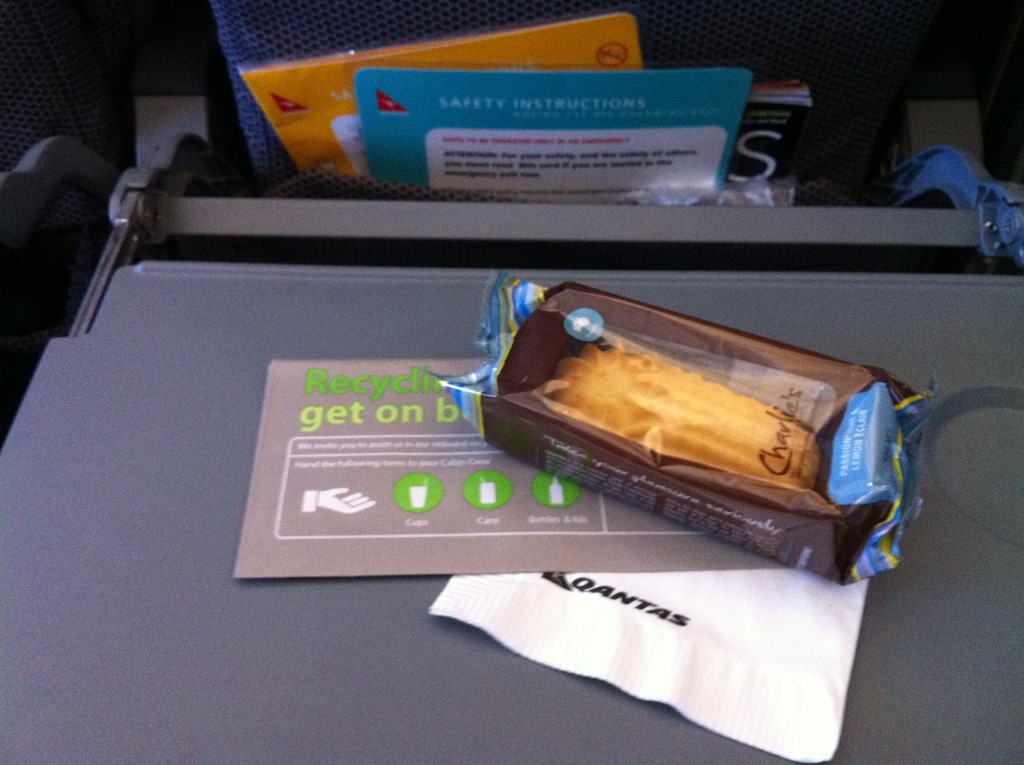
Well, my life as Punxsutawney Phil has swung full circle and I feel that I have been yanked from the hole again! The Guinness Book of Records sized Éclair is back!

IMG_0298

With all the excitement of the éclair and next weeks excitement where we get to see which toxic parliamentarian wins the leadership ballot for PM, I am keeping this one short. I think I should be PM. There is food for thought.

Happy travel’s

Customers, those pesky little vermin.

I was reading a tweet from Stephen Fry about a little problem he had with data on his mobile phone in New Zealand.  Telecom New Zealand were very fast to act on his problem and he acknowledged that be it in a very verbose 9 tweet essay.  The final tweet was the one that got me thinking:

image

This is a classic conundrum that Qantas face on a regular basis.  Rosco , a colleague of mine who clocks more hours in the sky than me was waiting at Sydney Domestic in the Business Lounge for a connecting flight when the lounge staff asked if he could move.  The reason for this move, the Kardashians were in the lounge and wanted to sit together.  Now I do not for a second believe that the Kardashians are generous with there disposal income towards the coffers of Qantas.  Rosco moved but had you or I walked into the lounge with 3 other people and asked the staff the move other guest for our benefit, well the response would be curt, to the point and lead to disappointment only reserved for the lowest of low, Frequent Flyers.  It is that old mantra, Celebrity Good, Regular Bad, who needs a profit when you have celebrities like the Kardashians spruiking your brand!

Another week, another, well where do I start…..

I was looking at my schedule yesterday and I have flown 59 legs this financial year, that is 59 trips to the airport, 59 scans and security screening and 60 times boarding (yep, that is not a misprint!).  It Friday and I am on my way home for another week,  You will be pleased to know that this week, Qantas got the plane allocation scheduling back on track and I did not have to go through the ringer to get my favourite exit seat.

1H12

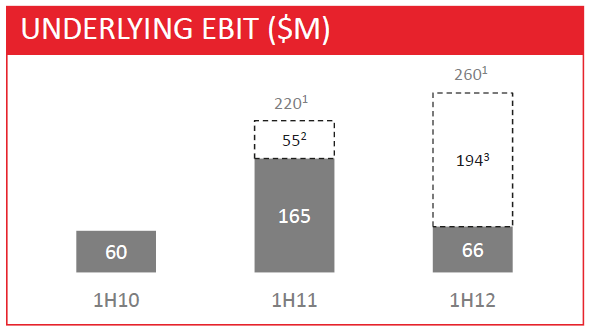
The big news of the week as the 1H12 Results delivered by Alan Joyce on Wednesday.  No real surprises in the commentary from Qantas.  Fuel was more expensive than ever, softer inbound demand from the UK and Europe, strong outbound growth (we Australians do love to travel) and robust domestic demand (see previous point).

image

The notes from Qantas noted that the Industrial dispute last year cost the airline $194m.  In the corresponding 1H11, the mess with Boeing and the A380 Grounding cost the airline $55m.  On top of this, the fuel bill went up $444m across the whole group for the period.  I can not help but think that if Alan Joyce had not grounded the Qantas fleet last year, the EBIT for the Qantas segment would be closer to $200m and Group EBIT in the region of $420m.  Now I am not privy to how Qantas keep their books and how the accountants came around the loses for the grounding but I can not help but think that it just does not add up and the PR team are being liberal with the facts.

You too can get all the commentary from Qantas at the Qantas Investor section of the web site.

Air Australia

Hardly competition but Air Australia (Strategic Aviation) brought the administrators in and left a number of Australians trapped in exotic locations.  Qantas and Alan Joyce to his credit has indicated that the stranded travellers should turn up at Qantas /Jetstar desks and Qantas will look to get them home.  It is nice to see Qantas using it’s considerable fleet for good and win some PR points in the process.  Nothing like reinforcing the brand to trapped travellers.

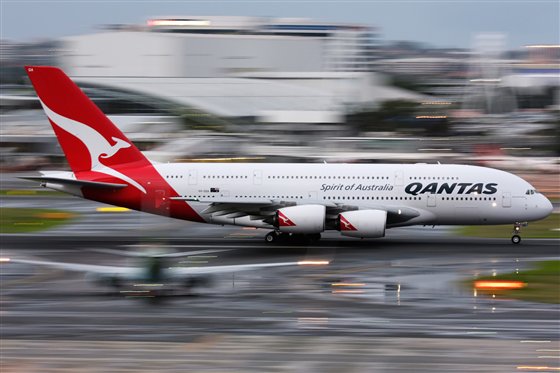
Qantas Airbus A380 fleet checked for cracks

Qantas will inspect its fleet of Airbus A380s for cracks on its wings following a European directive, but the engineers union says it should have happened months ago.

The airline will check all 12 of its superjumbo jets for structural damage on parts inside the wings following directions from the European Aviation Safety Agency EASA.  The agency last month issued an airworthiness directive calling for “a detailed visual inspection” of the 20 planes that have flown the most, but that has now been extended to the entire fleet of 68.  A Qantas spokeswoman said the airline would “comply fully with the EASA directives” and begin inspections in the next few weeks.  But Australian Licensed Aircraft Engineers Association ALAEA federal secretary Steve Purvinas said that while the inspections were necessary, they should have been made sooner.  Mr Purvinas said cracks were first discovered in the so-called “wing rib feet” — the metal brackets that connect the wings ribs to its skin — in several A380s in the global fleet months ago.”Weve been calling for these checks to take place for two months now,” Mr Purvinas said.  “It shouldnt have taken them two months to work out that these cracks are only going to get bigger, and the inspection should have been mandatory as its now been made.”

Senior aviation school lecturer at the University of NSW, Peter Marosszeky, said the checks were not cause for alarm, because the aircraft had only been flying internationally since 2007 and some were likely to have minor “teething problems”.Mr Marosszeky, also a former Qantas engineer, said the ordered checks on the aircraft were “an eminently sensible idea”.  He said cracks such as those discovered so far posed “no threat to safety”, and that routine checks meant it was “very unlikely” such cracks could worsen to the point of becoming dangerous.  However Mr Purvinas said the cracks were only first discovered by engineers carrying out repairs, and had not been picked up during routine checks.Qantas grounded one of its A380s on Sunday after 36 hairline cracks were discovered on its wings.  The plane was hit by severe turbulence last month on a flight from London to Singapore and seven people were injured.  Qantas said those cracks were “not related to the turbulence, or specific to Qantas”, but had been traced back to a manufacturing issue, and had no effect on flight safety.  It also said the type of cracking was different to cracking found on certain A380s in the global fleet.AAP

via Qantas Airbus A380 fleet checked for cracks.